Showing posts with label Astrophysicist. Show all posts

Monday, October 19, 2015

Jocelyn Bell Burnel (July 15, 1943 - Present)


Jocelyn Bell Burnell was born in Belfast, Northen Island. Her father was an architect for the Armagh Observatory, where Jocelyn spent much time as a child. At a young age she read a number of books on astronomy and her interest in the subject was encouraged by the staff of the Armagh Observatory. She attended Lurgan College and went on to earn a Physics degree at Glasgow University, Scotland in 1965. In 1969 completed her Ph.D. from the University of Cambridge, where under the supervision of Antony Hewish, she also constructed and operated a 81.5 megahertz radio telescope. She studied interplanetary scintillation of compact radio sources.

In 1967 Bell, while analyzing literally miles of print-outs from the telescope, noted a few unusual signals which she termed as “scruff”. These “bits of scruff” seemed to indicate radio signals too fast and regular to come from quasars. Both Jocelyn and Hewish ruled out orbiting satellites, French television signals, radar, finally even “little green men.” Looking back at some papers in theoretical physics, they determined that these signals must have emerged from rapidly spinning, super-dense, collapsed stars. The media named these as collapsed stars pulsars and published the story.

In 1968, soon after her discovery, Bell married Martin Burnell (divorced 1993). Her husband was a government worker, and his career took them to various parts of England. She worked part-time for many years while raising her son, Gavin Burnell. During that period she began studying almost every wave spectrum in astronomy and gained an extraordinary breadth of experience. She held a junior teaching fellowship from 1970 to 1973 at the University of Southampton where she developed and calibrated a 1-10 million electron volt gamma-ray telescope. She also held research and teaching positions in x-ray astronomy at the Mullard Space Science Laboratory in London, and studied infrared astronomy in Edinburgh.

Jocelyn did not share the Nobel Prize awarded to Hewish for the discovery of pulsars, but has received numerous awards for her professional contributions. She was first chosen as a fellow of the Royal Astronomical Society in 1969 and has served as its Vice President. Among many of her awards she received the Beatrice M. Tinsley Prize from the American Astronomical Society in 1987 and the Herschel Medal from the Royal Astronomical Society in 1989. She also won the Oppenheimer Prize and The Michelson Medal.

She is currently a Visiting Professor of Astrophysics at the University of Oxford and a Fellow of Mansfield College. Also Jocelyn is the current President of the Institute of Physics.

Friday, October 16, 2015

Sara Seager (July 21, 1971 - Present)


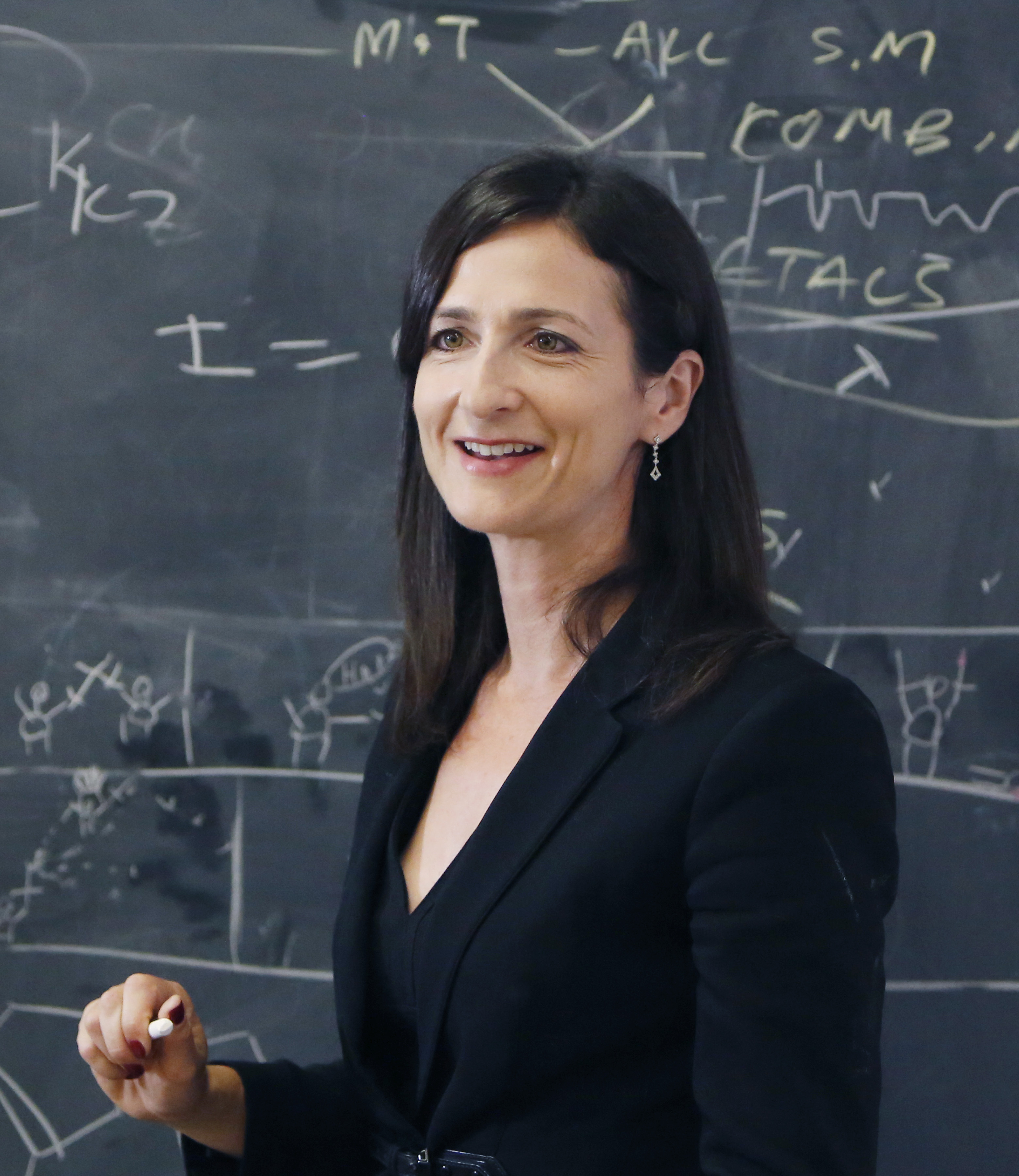
Professor Sara Seager is a planetary scientist and astrophysicist. She has been a pioneer in the vast and unknown world of exoplanets, planets that orbit stars other than the sun. Her ground-breaking research ranges from the detection of exoplanet atmospheres to innovative theories about life on other worlds to development of novel space mission concepts. Now, dubbed an "astronomical Indiana Jones", she on a quest after the field's holy grail, the discovery of a true Earth twin. Dr. Seager earned her PhD from Harvard University and is now the Class of 1941 Professor of Planetary Science and Professor of Physics at the Massachusetts Institute of Technology. Professor Seager is a 2013 MacArthur Fellow and was named in Time Magazine's 25 Most Influential in Space in 2012.

Seager was born in Toronto, Canada. She earned the degree of Bachelor of Science in Mathematics and Physics from the University of Toronto in 1994 assisted by a NSERC University Undergraduate Student Research Award and a Ph.D. in astronomy from Harvard University in 1999. Her doctoral thesis developed theoretical models of atmospheres on extrasolar planets.[9] She held a post-doctoral research fellow position at the Institute for Advanced Study between 1999 and 2002 and a senior research staff member at the Carnegie Institution of Washington until 2006. She joined the Massachusetts Institute of Technology in January 2007 as an associate professor in both physics and planetary science, was granted tenure in July 2007,[10] and was elevated to full professor in July 2010

 Before joining MIT in 2007, Professor Seager spent four years on the senior research staff at the Carnegie Institution of Washington preceded by three years at the Institute for Advanced Study in Princeton, NJ. Professor Seager is on the advisory board for Planetary Resources. Seager was elected to the National Academy of Sciences in 2015, is a 2013 MacArthur Fellow, the 2012 recipient of the Raymond and Beverly Sackler Prize in the Physical Sciences, and the 2007 recipient of the American Astronomical Society's Helen B. Warner Prize. She has been recognized in the media, most recently in Time Magazine's 25 Most Influential in Space in 2012.