Showing posts with label Biochemist. Show all posts

Monday, October 19, 2015

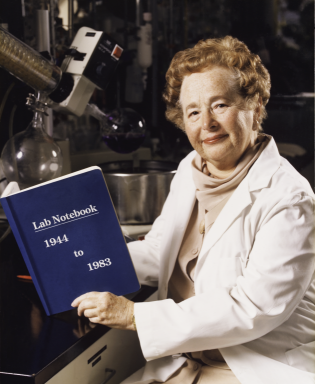
Gertrude Elion (January 23, 1918 – February 21, 1999)

American biochemist and pharmacologist Gertrude B. Elion helped develop drugs to treat leukemia and prevent kidney transplant rejection. She won a Nobel Prize for medicine in 1988.

Born to immigrant parents in New York City, Gertrude Elion spent her early youth in Manhattan, where her father had a dental practice. When her brother was born, the family moved to the Bronx. She attended high school and excelled with, in her words, an "insatiable thirst for knowledge."

Motivated by the death of her grandfather, who died of cancer, Elion entered Hunter College, in New York City, at age 15 and graduated summa cum laude in chemistry at age 19. She had difficulty finding employment after graduation, because many laboratories refused to hire women chemists. She found part-time jobs as a lab assistant and went back to school at New York University. Elion worked as a substitute high school teacher for a few years while finishing work on her master's degree, which she earned in 1941. Though she never obtained a doctorate degree, she was later awarded an honorary Ph.D. from Polytechnic University of New York and an honorary Doctor of Science degree from Harvard University.

The start of World War II created more opportunities for women in industry. Elion was able to obtain a few quality-control jobs in food and consumer-product companies before being hired at Burroughs-Wellcome (now GlaxoSmithKline) in 1944, where she began a 40-year partnership with Dr. George H. Hitchings. Her thirst for knowledge impressed Dr. Hitchings, and he permitted her to take on more responsibility.

Elion and Hitchings set out on an unorthodox course of creating medicines by studying the chemical composition of diseased cells. Rather than relying on trial-and-error methods, they used the differences in biochemistry between normal human cells and pathogens (disease-causing agents) to design drugs that would block viral infections. Elion and her team developed drugs to combat leukemia, herpes and AIDS. They also discovered treatments to reduce the body's rejection of foreign tissue in kidney transplants between unrelated donors. In all, Elion developed 45 patents in medicine and was awarded 23 honorary degrees.

Elion admitted that her work was her life, but she also enjoyed photography and travel, both products of her curiosity about life. She also enjoyed opera, ballet and theater. Though she never married, she enjoyed being the "favorite aunt" to her brother's children.

Gertrude Elion officially retired in 1983, but she remained active, holding the titles of scientist emeritus and consultant at her old company. She also served as an adviser for the World Health Organization and the American Association for Cancer Research.

In 1988, Elion received the Nobel Prize in Medicine, together with George Hitchings and Sir James Black. She received other awards for her work, including the National Medal of Science in 1991, and that same year, she became the first woman to be inducted into the National Inventors Hall of Fame. In 1997, she was granted the Lemelson-MIT Lifetime Achievement Award.

Sunday, October 18, 2015

Dorothy Crowfoot Hodgkin (May 12, 1910 – July 29, 1994)


Dorothy Mary Crowfoot was born on 12 May 1910 in Cairo, Egypt, to John Winter Crowfoot, an archaeologist and classical scholar, and Grace Mary Crowfoot née Hood, an archaeologist and expert on Ancient Egyptian textiles. She lived in the English expatriate community in Egypt, returning to England only a few months each year. During one of those stays in England, when Hodgkin was four, World War I began. Her mother lost four brothers in the war. Separated from her parents, who would return to Egypt, she was left under the care of relatives and friends until after the end of the war when her mother came to England for one year, a period that she later described as the happiest in her life.

In 1921, she entered the Sir John Leman Grammar School in Beccles. Only once, when she was thirteen, did she make an extended visit to her parents, who by then had moved to Khartoum, although both parents continued to visit England each summer.

She developed a passion for chemistry from a young age, and her mother fostered her interest in science in general. Her state school education left her without Latin or a further science subject, but she took private tuition in order to enter the University of Oxford entrance examination. At the age of 18 she started studying chemistry at the University of Oxford (Somerville College, Oxford).

She studied for a Doctor of Philosophy at the University of Cambridge under the supervision of John Desmond Bernal, where she became aware of the potential of X-ray crystallography to determine the structure of proteins, working with him on the technique's first application to the analysis of a biological substance, pepsin.

In 1933 she was awarded a research fellowship by Somerville College, and in 1934, she moved back to Oxford. The college appointed her its first fellow and tutor in chemistry in 1936, a post which she held until 1977. In the 1940s, one of her students was Margaret Roberts, the future Prime Minister Margaret Thatcher, who installed a portrait of Hodgkin in Downing Street in the 1980s.

Together with Sydney Brenner, Jack Dunitz, Leslie Orgel, and Beryl M. Oughton, she was one of the first people in April 1953 to travel from Oxford to Cambridge to see the model of the double helix structure of DNA, constructed by Francis Crick and James Watson, based on data acquired by Rosalind Franklin. According to the late Dr. Beryl Oughton, later Rimmer, they all traveled together in two cars once Dorothy Hodgkin announced to them that they were off to Cambridge to see the model of the structure of DNA.

In 1960, she was appointed the Royal Society's Wolfson Research Professor, a position she held until 1970. This provided her salary, research expenses and research assistance to continue her work at the University of Oxford.


Hodgkin was particularly noted for discovering three-dimensional biomolecular structures. In 1945, working with C. H. (Harry) Carlisle, she published the first such structure of a steroid, cholesteryl iodide (having worked with cholesteryls since the days of her doctoral studies). In 1945, she and her colleagues solved the structure of penicillin, demonstrating (contrary to scientific opinion at the time) that it contains a β-lactam ring. However, the work was not published until 1949.

In 1948, Hodgkin first encountered vitamin B12, and created new crystals. From these, she deduced the presence of a ring structure because the crystals were pleochroic, a finding which she later confirmed using X-ray crystallography. Scientists from Merck had previously crystallized B12, but had published only refractive indices of the substance. The final structure of B12, for which Hodgkin was later awarded the Nobel Prize, was published in 1955.

Insulin was one of her most extraordinary research projects. It began in 1934 when she was offered a small sample of crystalline insulin by Robert Robinson. The hormone captured her imagination because of the intricate and wide-ranging effect it has in the body. However, at this stage X-ray crystallography had not been developed far enough to cope with the complexity of the insulin molecule. She and others spent many years improving the technique. Larger and more complex molecules were being tackled until in 1969 – 35 years later – the structure of insulin was finally resolved. But her quest was not finished then. She cooperated with other laboratories active in insulin research, gave advice, and traveled the world giving talks about insulin and its importance for diabetes.

Sunday, September 14, 2014

Marie Maynard Daly (April 16, 1921 – October 28, 2003)

Marie M. Daly
Marie Maynard Daly was an American biochemist. She was the first Caribbean American woman in the United States to earn a Ph.D. in chemistry (awarded by Columbia University in 1947).

Daly's father had immigrated from the British West Indies, found work as a postal clerk, and eventually married Helen Page of Washington, D.C. They lived in New York, and Daly was born and raised in Corona, Queens. She often visited her maternal grandparents in Washington, where she was able to read about scientists and their achievements in her grandfather’s extensive library. She was especially impressed by Paul de Kruif’s The Microbe Hunters, a work which partially influenced her decision to become a scientist.

Daly’s father, who had attended Cornell University with intentions of becoming a chemist, was unable to complete his education due to a lack of funds. His daughter continued her father’s legacy by majoring in chemistry.

After Daly graduated from all-girls Hunter College High School (where she was also encouraged to pursue chemistry), she enrolled in Queens College, a small, fairly new school in Flushing, New York. She lived at a home to save money, majored in chemistry, and graduated from Queens magna cum laude with her bachelor's degree in chemistry in 1942.

Daly remained at Queens College for another year, working as a laboratory assistant while attending graduate school at New York University. She completed her masters in Chemistry in 1 year. She then enrolled in the doctoral program at Columbia University, where she was supervised by Dr. Mary L. Caldwell. Caldwell, who had a doctorate in nutrition, helped Daly discover how chemicals produced in the body contribute to food digestion. Daly completed her Ph.D. in chemistry in 1947. Her dissertation addressed “A Study of the Products Formed by the Action of Pancreatic Amylase on Corn Starch.”

Daly served two years as a physical science instructor at Howard University. After being awarded an American Cancer Society grant to support her postdoctoral research, she joined Dr. A. E. Mirsky at the Rockefeller Institute, where they studied the cell nucleus. In 1953, after Watson and Crick described the structure of DNA, Daly’s world changed significantly: suddenly, the cell nucleus research field was flooded with funding opportunities. Her work flourished in the new environment.

In 1955 Daly returned to Columbia’s College of Physicians and Surgeons to teach biochemistry. She began collaborating with Dr. Quentin B. Deming to investigate the underlying causes of heart attacks. They found that high cholesterol levels contributed to the blockage of arteries that supply oxygen to the heart. She also investigated the effects of sugar on the function of coronary arteries. Later, she became a pioneer in studying the impact of cigarette smoking on the lungs.

In 1960 Daly and Deming moved to Yeshiva University at the Albert Einstein College of Medicine in New York City. At Yeshiva, she continued her research and taught biochemistry courses. She enjoyed teaching medical students and was dedicated to increasing the number of minority students enrolled in medical schools. In 1961 Daly married Vincent Clark.

Daly also served as an investigator for the American Heart Association; she was especially interested in how hypertension affects the circulatory system. She was a member of the prestigious Board of Governors of the New York Academy of Sciences for two years. Daly retired from the Einstein College of Medicine in 1986, and in 1988 she established a scholarship for African American chemistry and physics majors at Queens College in memory of her father.